[bt_section][bt_row][bt_column width=”2/3″ align=”left” vertical_align=”inherit” border=”no_border” cell_padding=”default” animation=”no_animation” text_indent=”no_text_indent” background_color=”” transparent=”” el_class=”” el_style=””][bt_header superheadline=”” headline=”About The Project” headline_size=”medium” dash=”no” subheadline=””][/bt_header][bt_header superheadline=”” headline=”PROJECT LOCATION” headline_size=”small” dash=”no” subheadline=”Winters, California” el_class=”” el_style=””][/bt_header][bt_header superheadline=”” headline=”CLIENT” headline_size=”small” dash=”no” subheadline=”California Department of Transportation (Caltrans)” el_class=”” el_style=””][/bt_header][bt_text]
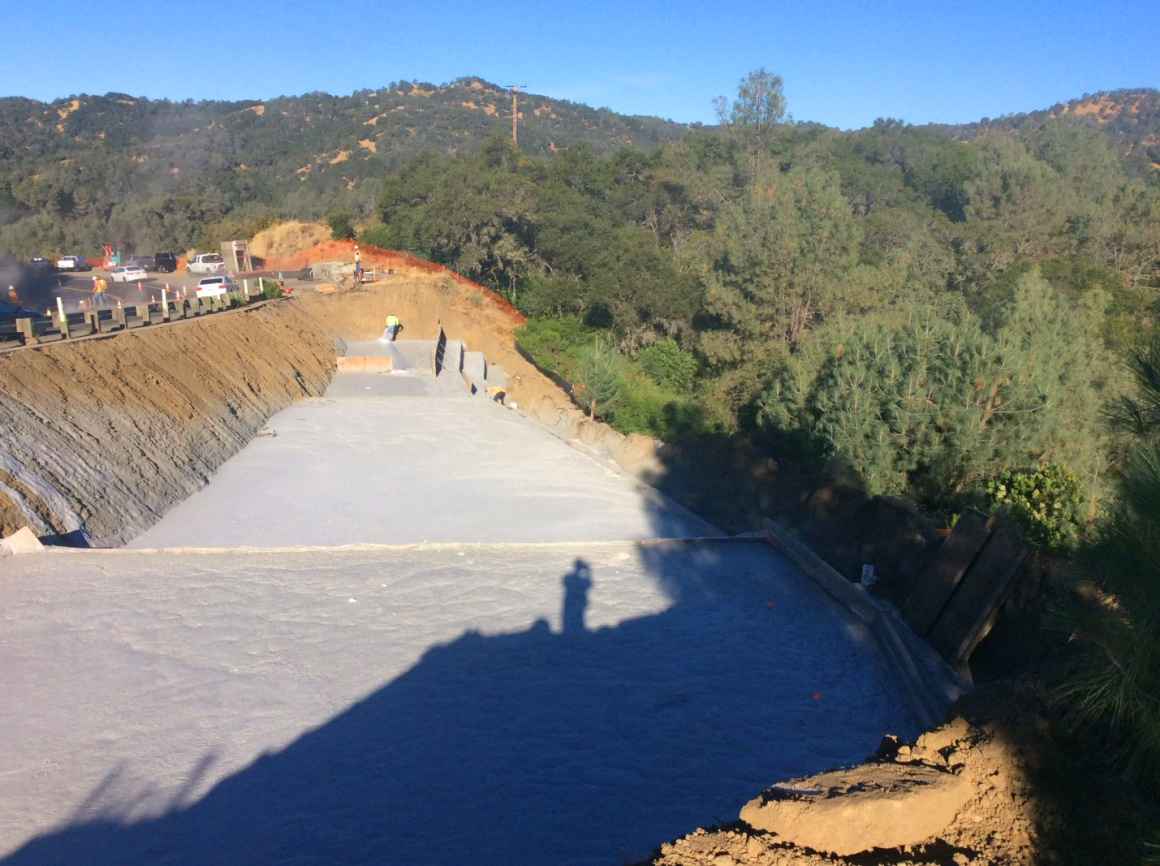
In 2015, Caltrans advertised a project to repair an unstable slope on Highway 128 (west of Winters, CA). According to the Preliminary Geotechnical Report (PGR) dated March 4th, 2014, the roadway was constructed on a poorly made fill slope that caused slip outs in the winter.
The PGR recommended removing the bulk of the slide debris and a portion of the underlying soil before reconstructing the fill slope with Expanded Polystyrene (EPS) Geofoam blocks. Replacing the poor material with EPS serves two functions: it increases shear strength of the low-strength, poorly compacted fill, and its light weight reduces the driving forces on the slide. Bid tabulations indicate that bid prices for the EPS ranged from $130/CY to $170/CY.
[/bt_text][bt_header superheadline=”” headline=”The Solution” headline_size=”medium” dash=”no” subheadline=”” el_class=”” el_style=””][/bt_header][bt_text]
Cell-Crete Corporation, as a subcontractor to the winning general contractor (GC), worked to submit a Cost Reduction Incentive Proposal (CRIP) to the State to replace the EPS blocks with Cell-Crete’s Lightweight Cellular Concrete (LCC). Cell-Crete’s LCC mixes cement slurry with a preformed foam to create a final product with a low unit weight and moderate strength. Once cured, the LWCC is similar to pumice. The mix design submitted had a cast density of 27 PCF (pounds per cubic foot) and an unconfined uniaxial compressive strength of 40 + PSI at 28 days.
[/bt_text][/bt_column][bt_column width=”1/3″ align=”left” vertical_align=”inherit” border=”no_border” cell_padding=”btDoublePadding” animation=”no_animation” text_indent=”no_text_indent” background_color=”” transparent=”” el_class=”” el_style=”padding-right: 0;”][bt_header superheadline=”” headline=”Project Assets” headline_size=”medium” dash=”no” subheadline=”” el_class=”” el_style=””][/bt_header][bt_button text=”Project Data” icon=”fa_f1c1″ url=”https://cell-crete.com/build/wp-content/uploads/2020/04/Project-Spotlight-CA-DOT-04-2G9504.pdf” target=”_blank” style=”accent” size=”small” width=”full” el_class=”” el_style=””][/bt_button][bt_hr top_spaced=”topSmallSpaced” bottom_spaced=”not-spaced” transparent_border=”noBorder” el_class=”” el_style=””][/bt_hr][bt_button text=”Project Image Gallery” icon=”fa_f1c5″ url=”https://cell-crete.com/build/ca-dot-04-2g9504-gallery/” target=”_blank” style=”accent” size=”small” width=”full” el_class=”” el_style=””][/bt_button][/bt_column][/bt_row][/bt_section]